
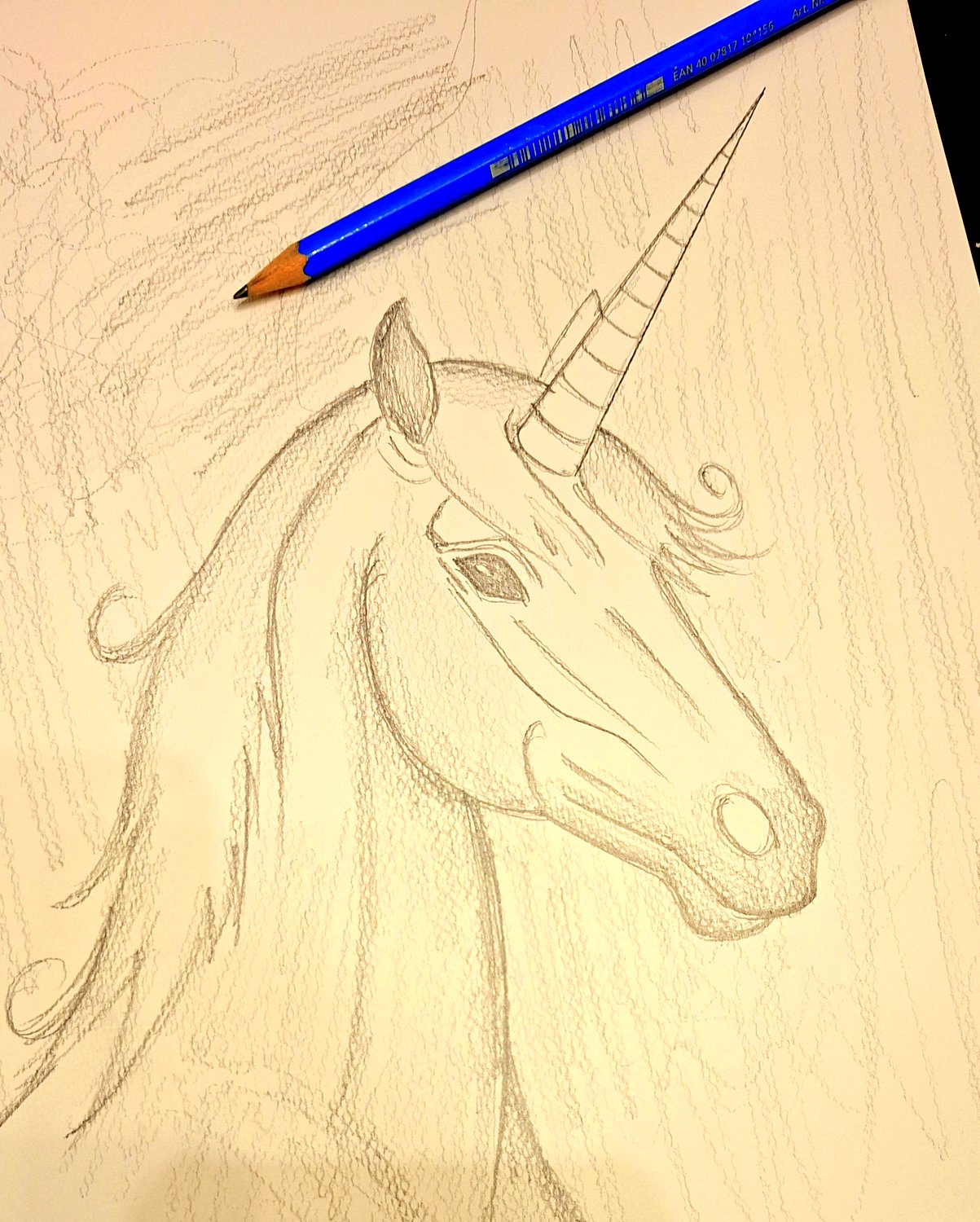
While doodling my unicorn again, I found myself thinking about fantasy. Not as magic, a pause button. Comfortable. And, at times, dangerous.
Fantasy isn’t always harmless. It becomes a problem when it replaces action. Fantasy gives the mind what reality hasn’t yet delivered: clarity, certainty, perfect outcomes. It lets desire exist without risk. Wanting without moving. Imagining without building.
The longer someone stays inside fantasy, the easier it becomes to delay real decisions. Action introduces effort, failure, and uncertainty. Fantasy protects us from all three. This is why fantasy fades the moment a person starts to act. Not because the dream collapses, but because growth no longer needs it.
Fantasy is useful when life feels unreachable. But presence begins when the dream stops standing in for the work.
Real change doesn’t start with clarity. It starts with a decision. The moment someone gets real, stops negotiating with possibility and chooses a direction, not from a fantasized future but from reality, fantasy loses its function. It isn’t because the dream was wrong, but waiting is no longer acceptable.
This is also the moment manipulation breaks. Fantasy keeps people suspended in “maybe.” A decision collapses the timeline into now. And that is when things actually change.

With art, however, it’s a completely different story. In life, fantasy can delay action. In art, fantasy becomes imagination.
When I create, fantasy doesn’t replace reality… it translates it. Or at times translates what I hoped to exist. It doesn’t suspend decisions. It sharpens them. It doesn’t keep me waiting. It gives form to what I’ve already chosen to face. Imagination in art is not an escape from the real. It is a way of processing it.
Fantasy becomes dangerous when it replaces living. But in art, it becomes a language. Something that moves creation forward, not life aside.
So what about MANIFESTATION and its talk about being “delulu” to bridge a certain gap?
According to my research, fantasy is often confused with manifestation. They look similar on the surface, both involve imagining a future (obviously.) But psychologically, they operate in opposite directions.
Fantasy consumes the feeling of the outcome. Manifestation demands behavioral change to create it. Manifestation, if it is real at all, is behavioral. It changes what you do, how you choose, what you tolerate, and what you repeatedly act upon.
Moreoever, this is where people slip into something close to delusion. When imagination replaces feedback from reality, when signs are interpreted only to protect a “preferred story,” fantasy stops being creative and starts becoming a closed loop.
In that state, fantasy doesn’t support manifestation. It blocks it. Because the mind is already consuming the emotional reward of the future, without doing the work that would create it (Inspired Action.) Manifestation only survives contact with reality. Fantasy avoids it.
So the difference is simple: If imagining your future makes you more precise, more disciplined, and more willing to act, it is aligned with creation. If imagining your future makes you more passive, more patient with ambiguity, and more dependent on signs instead of decisions, it is fantasy.
And fantasy, left unchecked, can turn intention into delay.
One clarification before I continue: a clear no is not something to “work through.” It changes the conversation entirely.
More about that later.🐎
I create digital and traditional art inspired by nature, music, life, and spirituality. writeme@lheanstorm.com for Commissions, Web3 collabs & Inquiries.


You must be logged in to post a comment.